March Issue

Updated: Mar 10
This issue of The Scuttle might just be our most comprehensive yet. We recently expanded our team and now have four regular contributors. In February, we really managed to capture an array of happenings and voices on the Cabrillo campus and within the wider community.
February was Black History Month, and Scuttle writer and editor Josephine Fahey wrote a remarkably impactful story about the experiences of black students at Cabrillo and in Santa Cruz County. Fahey interviewed several individuals and detailed her own experiences as an Ethiopian-American Cabrillo student. Speaking of student experiences, I talked to a couple of folks from Rising Scholars to gain some insight into what Cabrillo College is like for formerly incarcerated students. You can read what they had to say below.
Our columnists, Rocco Arnott and Lizzy Sterling, decided to zoom out a bit and cover some goings-on throughout the county. In his column, Whereabouts, Arnott shares a couple of outdoorsy spaces that opened recently: Cotoni-Coast Dairies (north of Davenport) and The Park at Rispin Mansion in Capitola. Read his piece below to learn more about these exciting new locations. On a more somber note (music pun not intended), you've likely all heard the sobering news about the future of The Catalyst in Downtown Santa Cruz. For The Scene this month, Sterling covered the latest updates regarding the beloved music club's fate and got one Cabrillo student's thoughts on the matter. Read all of this and more below. Lastly, yes, we have a new logo! Thank you to Josephine for coming up with the design!
As always, we welcome feedback, inquiries, and submission requests. To contact us, send an email to jofahey@cabrillo.edu or isblevin@cabrillo.edu (or both)!
–Isabella Blevins
Announcements
Childcare & Textbook Reimbursement
Spring 2026 marks the final semester for childcare and textbook reimbursement. Spread the word about this opportunity to anyone who may benefit from it! The funding for this program will run out in June. To apply, fill out this form as soon as possible.
President Jenn Capps’ ‘Idea Catcher’
Visit the president’s webpage to access President Jenn Capps’ Idea Catcher. Students, employees, and community members may use the provided google form to deliver feedback or suggestions directly to the college president.

Palouse Review Seeking Honors Students Submissions
The Palouse Review is currently accepting submissions from honors students interested in publishing their work in a literary arts journal. Students are invited to submit scholarship, poetry, art, photography, music, fiction, and nonfiction. Submissions are due by March 22, 2026 and can be submitted online at palousereview.wsu.edu.
Student Senate Application Open
Interested in running for student senate for the 2026-27 academic year? Use this link to fill out an application once you’ve decided which position you’d like to fill. For more information about roles and expectations, check out the ASCC Senate Bylaws.
Upcoming Events
Career Services Workshops
On March 10th from 5:00- 6:00pm, join a Zoom workshop with Career Services that will help students develop a LinkedIn profile that stands out and the importance of online networking. Register here.
Additionally, head over to the Santa Cruz Beach Boardwalk for a Skilled Trades Job Fair on March 18th from 4:00-6:30pm.
Cabrillo Day for the Santa Cruz Warriors
Students get discounted tickets to the Santa Cruz Warriors Basketball game on March
19th at 7pm. All proceeds go to Cabrillo College!

Basketball with the President
Join President Dr. Jenn Capps and Dr. Devin Walker on March 6th at 11:30am in the Cabrillo Gym for an afternoon of pickup basketball and free pizza! This is a great opportunity to get to know your new college president! Scan the QR code on the flyer to sign up.
Fresh Market
Save the date for the Spring 2026 Fresh Markets! Free food for ALL Cabrillo students.
You can also receive assistance with completing CalFresh applications during Fresh Markets. Bring your own grocery bag! Additionally, sign up to volunteer at a Fresh Market!
Aptos Fresh Markets at the Aptos Library Plaza
Monday, March 9, 9:30 a.m. – 11:00 a.m.
Monday, March 30, 9:30 a.m. – 11:00 a.m.
Watsonville Fresh Markets at the Watsonville NEST (Classroom A140)
Wednesday, March 11, 11:00 a.m. – 12:30 p.m.
Santa Cruz: The Black Experience
There is currently a 1% Black student population at Cabrillo College, which is reflective of the 1.6% in the whole of Santa Cruz County. In an area that prides itself on progressiveness and claims to be ethnically tolerant, how does the Black community find belonging? In recent years, it seems as though many have been reexamining racial biases on a personal and institutional level. There is a high level of conviction that the Santa Cruz County and Cabrillo Community hold regarding their level of cultural competence. Given the communities' avowed forward ideals, do Black people in these communities agree?
In 2019, I moved to Santa Cruz from Oakland, California. Navigating my first year of high school in a new area was my biggest worry until I was confronted with the absurd reality of being one of the very few black-identified students at my school and an even more alarming amount of ignorance and bigotry.
I am mixed-race, with Ethiopian and American heritage. Growing up in Oakland and being surrounded by Ethiopian and Black culture was never something I thought I would have to cherish, especially in the academic realm. I never knew what “culturally relevant coursework” was, and I never knew what “reexamining cultural biases” was. I never knew that people had to make an effort not to be racist… until I moved to Santa Cruz.
Upon my displacement, I found myself to be the target of ignorant racial biases from both instructors and students. I learned very quickly that the amount of acceptance my school had was incorrectly self-proclaimed and never backed by action or words. And this sentiment translates well to the community overall.
Maleah Benjamin, a 21-year-old medical assistant major here at Cabrillo shared her experiences as a mixed-race African-American and Filipino living in Watsonville.
Benjamin has lived in Santa Cruz County for 19 years. In elementary school, she faced similar struggles and had to deal with bigotry regularly. Students would make insensitive racial jokes at her expense and call her names.
“I grew up being like one of, maybe two if I'm lucky, usually just the one black girl in my school,” Benjamin says.
Benjamin recalled a time in elementary school when a classmate made a racist joke, to which she used physical violence as a response. As Benjamin grew older, she learned to use humor or sarcasm to negate it, but she questions why she has to experience racism in the first place.
“Why is that the case? Why aren’t they knowing better from home? And that’s what scares me, honestly.”
Benjamin says she identified more with her Filipino heritage due to the outstanding community in Watsonville. But as a black-presenting individual, it was hard find belonging.
“It was hard to figure out where I fit, which ultimately came down to nowhere.”
In a 2018 focus group study by the Community College Equity Assessment Lab (CCEAL), it was found that “African American students did not feel a sense of belonging at Cabrillo and reported experiencing racial microaggressions on an ongoing basis—both on campus and in the Aptos community.”
Despite the adversity she faced in her adolescence, Benjamin was impressed by the warmth of Cabrillo, specifically the Equity Department. She says Devin Walker, Dean of Student Equity, and Alta Cilicia Northcutt, Director of Student Life and the Umoja Program, were leading agents of her scholastic success. But the outreach Cabrillo currently provides to Black students was a struggle to achieve.
Northcutt commented on the difficulty of maintaining a black-centered program before Umoja arrived at Cabrillo. Northcutt said that fluctuating enrollment rates and participation of black-identified students prevented the long term establishment of Black student interest groups. Additionally, students felt discouraged because of the national scrutiny of being black during the crux of the Black Lives Matter movement in 2020.
After the political climate calmed, there was a surge of students eager to reclaim the community they had lost. Unfortunately, there was heavy objection by certain members of the Cabrillo administration. Despite the demur, the Black constituents of Cabrillo persisted and established the successful and ever-growing Umoja program.
The Cabrillo administration and board are notoriously understood as tenets of the deep-rooted institutional racism of Cabrillo. I wish it could be said that all leaders of our institution are catalysts of change or embody the College’s Mission statement, but that would be a falsehood.
During a recent Governing Board meeting, a board member made a highly insensitive comment towards a Black staff member, ironically, during a resolution discussion for the continuance of support for Black History Month.
The trustee explicated their disapproval of a racist post made by President Trump, depicting Former President Barack and Former First Lady Michelle Obama as monkeys. The trustee then singled out a Black administrator, saying the post reminded them of said administrator, and asked the target if they had any comments regarding the post.
The comment was highly problematic and not the first time the board has proved its racial ineptitude. The comment not only targeted and ostracized the administrator and the three other Black individuals in the room, but also publicly exposed the trustee's racial biases and personal ruminations.
Among the emotional burdens of being Black in Santa Cruz County, the community suffers a disproportionate amount of inequalities compared to other racial identity groups, and this is statistically proven by persistent equity gaps in education, finance, housing, and food security. According to Cabrillo College's Student Equity and Achievement statistics (SEA Plan), there is a consistent 10% equity gap in success and completion between minoritized and majoritized students. In Fall 2025, Black students had a 65% course success rate (finished courses with a C or higher).
Additionally, in a #RealCollege California Basic Needs Climate survey in spring 2023, 89.09% of Black Cabrillo students experienced housing insecurity, compared to 55.48% overall, and 56.6% of students self identified as homeless, compared to 22.61% overall. In the same study, 85.45% of Black Cabrillo students experienced food insecurity compared to 52.02% overall, and 60% of Black students said they didn't eat for a whole day because they couldn't afford food.
Despite the prevalent obstacles that the Black community faces, there are pockets of joy and a shared sense of resilience. Among the students that I interviewed, the Umoja Program and community are large contributors to their sense of belonging.
Jordan Simpkins, a 21-year-old African American, health science major, and Cabrillo athlete, says that she didn't get involved with Umoja until her second year at Cabrillo.
“I was a little lonely. Like, ‘where are the people I can make jokes and laugh with?’”
Originally from South Carolina and Mississippi, Simpkins noted the struggles of moving to a predominantly white area. She specifically noted how hard it was to make Black friends outside of school and the difficulty of not having black hair specialists in her area.
Simpkins explained that upon joining Umoja, she felt more “at home.”
“Umoja has put that emptiness away and filled my heart…” says Simpkins.
Chidinma Kalu, a first-year Nigerian student studying business at Cabrillo, shares a similar sentiment. She feels especially welcomed by Umoja and the staff in the Multicultural Student Center.
Kalu moved to Scotts Valley three years ago and has appreciated the diversity of Santa Cruz, but being the only Black person in a room can make her feel “like one of many.” She often commented that she's not easily bothered by the benign racial biases of others, partly because of her internal confidence, but also her educational goals and ability to self-advocate.
Particularly interested in dance, Kalu was disappointed in the lack of diversity provided by the Cabrillo dance program.
“I wanted to join the dance classes and realized the styles I wanted to do were kind of watered down.”
Kalu emphasized that that was her only grievance, and otherwise feels very seen and supported by the Cabrillo community. She explains that Umoja has been a wonderful resource and has greatly helped her integrate herself as a Black student.
She says, “It’s very rare, you mostly walk around just braving it and just not caring, but then you meet the people, and you're like ‘Oh my goodness!’”
The isolation and quiet sadness that Kalu and Simpkins described are felt throughout the Black community here in Santa Cruz. The uniqueness of adversity makes it even harder to share. Instances of bigotry, such as singling out Black voices or self-proclaiming righteousness, may not come from malicious intent but accomplish the same amount of harm as explicit racism and, moreover, create an atmosphere that excludes black authenticity. It is an invisible burden that Black people shoulder.
Programs with the overarching goal of Black excellence and joy are a tribute to the resilience of the community. Umoja, Black Surf Santa Cruz, and Santa Cruz Black , among others, are what bring an otherwise separated community together. Despite the inordinate labors of simply existing as a Black individual, the strength and richness of culture permeates regardless.
–Josephine Fahey
Club Spotlight
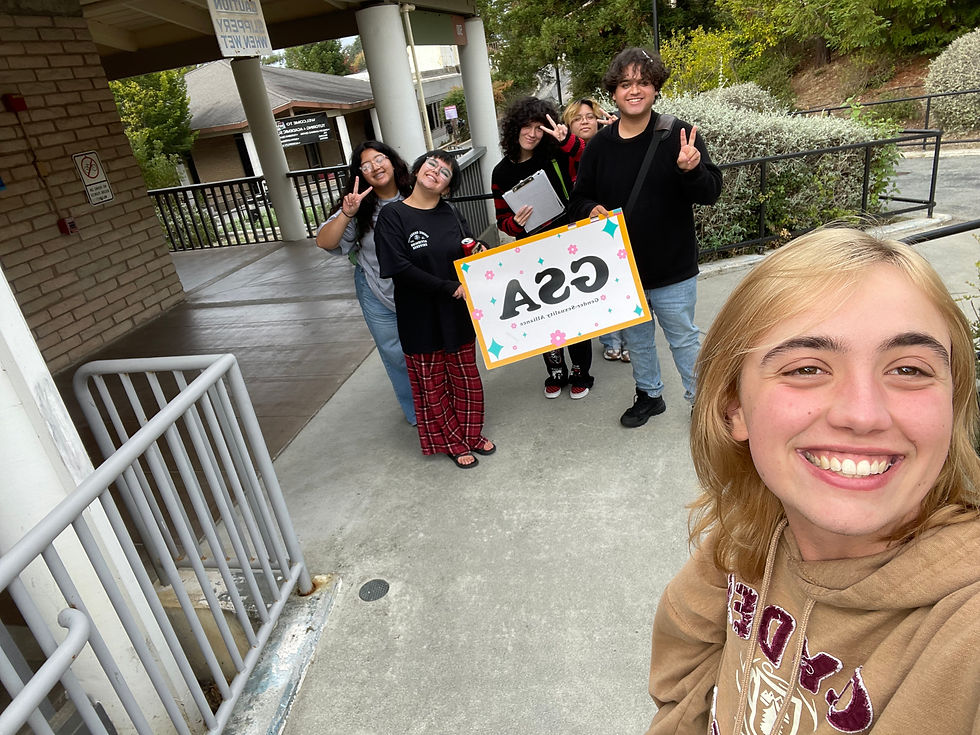
GSA Club
The Cabrillo Gender and Sexuality Alliance (GSA) is a safe space on campus for LGBTQIA+ students to become involved in the community and explore their identity. The club meets weekly at the Cabrillo Library's Rainbow Lounge (up the stairs and in the room to the right with the pride flags on the window), on Tuesdays from 4 to 5pm. We often table at community events and host club events on and off campus. Some of our upcoming events include a Drag Show at the Multicultural Student Center where we will be hosting two student drag performers on Friday, February 27th from 1 to 4pm. There will be music and food, and it will be a super fun time. There is also our upcoming Gothic Ball on April 25th, which is a LGBTQIA+ prom event that we have done annually where we celebrate with our fellow students and dance the night away.

It has been an amazing experience to be an advocate and leader for the LGBTQIA+ students on campus, and I am very proud of the work we have done. It's very comforting to get to connect with your peers, and we are always looking for more people to join our mission of inclusion and our community. My favorite part of the week is getting to sit down with the club every Tuesday and hear how everyone's week has been and gather new insights on the events we are planning. All are welcome to join our meetings and attend our events, and we hope to see you soon! –Mike Berlin, GSA President (they/them)

Cabrillo College Through the Eyes of a Formerly Incarcerated Student
One of the numerous student-oriented programs at Cabrillo College, Rising Scholars supports college students who are formerly incarcerated or have been in some way impacted by the justice system.
According to program coordinator Effron “Donnie” Veal, it currently serves more than 125 Cabrillo students.
One of these students is Brian Sellen, 46, who started taking classes at Cabrillo in August 2024. Sellen was in and out of the prison system from about 1990 to March 2024. That year, he decided to return to school. He was 10 credits away from receiving his high school diploma, so he started with that. In addition to being a college student, Sellen also balances two jobs and raising his seven-year-old daughter. Later this year, he plans to transfer to UCSC where he will continue working towards his Criminal Justice degree with the goal of becoming an attorney.
“I was in there being exposed to the criminal justice system and being in and out of the courtroom... I started advocating for myself and started realizing maybe I could turn this into something [and] leverage the learned experience," he said.
Currently, the recidivism rate in the United States is between 68% and 70% for formerly incarcerated individuals who are rearrested within three years of release. However, for individuals who earn an associate’s degree, that percentage drops dramatically to between 8.5% and 13.7%. For those who earn a bachelor’s degree, the recidivism rate is 5.6%. Earning a master’s degree brings the likelihood of recidivism down to zero.
Although education is demonstrably successful in reducing recidivism, the journey from prison to college is not easy.
“You feel imposter-ish a little bit. Like am I going to be able to elevate a conversation around a bunch of kids who are coming out of high school or who are young adults? Am I going to be able to elevate a conversation with a professor?”
He described how difficult it was to adjust to a new kind of mindset necessary for college life after becoming used to the hardened, survivalist outlook that incarceration required.
Not all of the challenges are internal, though.
When I interviewed Sellen for this article, he told me he’d received a discouraging comment from a professor regarding his plan to attend UCSC as recently as earlier that day.
“In the past, if I wasn’t this far along in my education, it would’ve derailed me to be honest,” he said.
Sellen said that although people on campus can be judgemental when they first learn about his past, he’s found that having positive interactions help break down the social barriers between himself and others.
While navigating the challenges brought forth by adjusting to college life, Sellen said he was inspired by Veal’s story, which he told in his April 2024 TED Talk.
Veal, the Rising Scholars program coordinator, described how different and alienating being on a college campus felt after being incarcerated.
“After being on a level four prison yard for 23 years, there were some things that just became natural to me. It’s true what they say about always having your head on a swivel–always looking around, looking at people’s tattoos, doing all of those things to make sure that you’re safe on a prison yard.”
When he came to Cabrillo, Veal said he was still “mentally incarcerated.” Pre-Covid, the Cabrillo campus brimmed with students and activity. He said it was also difficult to adjust to being in crowds and having people disregard his personal space. In prison, he’d been required to be hyper-aware of the positions of others around him.
“I had to remind myself to turn those defense mechanisms off,” he said.
Veal became the first program coordinator of Rising Scholars at Cabrillo and played a large role in starting the program in June 2023. He was released from prison in October 2019 after having been involved in a non-fatal shooting that resulted in a 23-year sentence. He came to Watsonville to live with his brother and go to college and began taking classes at Cabrillo in January 2020. From there, he transferred to UCSC where he finished with a bachelor’s degree in Sociology in 2024. At UCSC he had been a part of Underground Scholars, a University of California organization for justice-impacted and formerly incarcerated students.
He remembers feeling nervous when he first applied to the coordinator position at Cabrillo. He worried he wouldn’t be considered because of his conviction history and limited resume. But his brother encouraged him to apply anyway.
“Having the experience that I have and doing the journey that I did, I think they felt like I was the best messenger [for] this position. In this instance my checkered past actually worked in my favor.”
Veal said Rising Scholars and its affiliated programs have been mostly successful in helping system-impacted students with college. Rising Scholars helps remove barriers to education by purchasing textbooks for them, letting students borrow laptops, and giving them priority registration for courses. An associated program on campus is Guardian Scholars, which provides support for college and dual-enrolled students who have been impacted by the foster care system. Sellen said that as a youth he was in the foster care system. He also said that only 10% of foster youths…He works part-time as a student assistant in the Guardian Scholars office.
Despite the positive effects Rising Scholars has so far had, Veal said that “Biases still exist on campus.”
“The biggest impact we want to make is just awareness to those people who have no idea about these experiences,” he said.
He wants Rising Scholars to keep breaking down people’s preconceived notions about formerly incarcerated people. One way to help with this is for the program to have more of a presence on campus. Rising Scholars occupies part of the bottom floor of the SAC West building on Cabrillo’s Aptos campus. Veal said he wants a bigger office space for the organization and to hold more events and work more towards spreading awareness.
Ultimately, Veal wants to expand the educational opportunities available to individuals affected by the justice system. He’s experienced firsthand the redeeming effect higher education has on formerly incarcerated people, yet, he said that education is not being promoted enough. When he was in prison, rooms that had been designated as classrooms were used as storage spaces.
“If education has such a transformative impact, why isn’t it being pushed more?”
–Isabella Blevins
The Next Steps for Cabrillo’s Pedestrian Bridge
The pedestrian bridge that connects the north side of Aptos campus to the south side has been a crucial resource for student accessibility. Destroyed on January 8th, 2024 by a vehicle exceeding the 15-foot limit, the footbridge has remained closed. Cabrillo College recently received updates on its rebuilding.
The bridge was rammed into by an excavator being towed by a dump truck and hasn't reopened since. At the time of the incident, the projected timeline for completion was summer 2026. There had been no further updates until February 9th of this year.
The bridge was built in 1963, just two years after the college was founded, and has served Cabrillo students for 61 years. The original bridge was built before the Americans with Disabilities Act, passed in 1990. Now the bridge is being redesigned to be compliant with the accessibility requirements.
At the Governing Board meeting on February 9th, the awarded insurance bid was announced for $6,034,033 toward the rebuilding of the pedestrian bridge.
“The Design and Permitting phase of the project shall begin immediately, with a targeted estimated construction completion date of January 2027. Cabrillo is excited to partner with Suffolk Construction Company, Inc. on this project to restore an accessible and safe path of travel over Soquel Drive for our students.”
–Josephine Fahey
A Conversation with the New President of Cabrillo College
In January, Cabrillo College welcomed Jenn Capps, its new president. She replaced Matt Wettstein who had spent nearly eight years in the position and retired in December.
Capps has arrived at an opportune time to help affect change and progress, as the college faces existential challenges such as financial deficit and low enrollment.
In February, I sat down with Capps in her Watsonville campus office to give our readers a sense of the person who is now at the helm of our institution, as well as some of the aims and goals she’s bringing to the position.
Capps served as Vice President of Academic Affairs at Cal Poly Humboldt for over five years. She said she always wanted to be involved in community college leadership and the opening at Cabrillo was a great opportunity.
“This is a solid campus with great students, great faculty, and a wonderful place, like, you can’t beat Santa Cruz County if you ask me.”
At Humboldt, she oversaw the university’s shift from a California State University to a polytechnic identity. Although that was certainly her largest accomplishment there, Capps also found fulfillment in supporting the university’s educational programs, such as Project Rebound. Similar to Cabrillo’s Rising Scholars program, Project Rebound aids justice-impacted and formerly incarcerated college students. Her involvement in Project Rebound allowed for the creation of a bachelor’s program at Pelican Bay State Prison in Crescent City and a second-chance Pell Grant awarded to the participants of that program.
She said she was also heavily involved in Cal Poly Humboldt’s study abroad program. In partnership with Cabrillo’s Equity and Student Success Director, Devin Walker, Capps hopes to expand Cabrillo’s study abroad opportunities. She said she is friendly with Vicente Fox Quesada, the former president of Mexico, and has led study abroad initiatives to the country before–particularly for students in health and medical disciplines, but not exclusively for those students. She said she would love to bring that same program to Cabrillo, especially because of the college’s allied health programs.
“I’ve taken students from my two previous colleges and universities there on study abroad to do service learning…It’s been a really amazing experience for them.”
Right now, one of the most urgent issues Cabrillo faces is low enrollment. Capps explained that the college is receiving funding for more students than it actually has. However, she said Cabrillo has an MOU (memorandum of understanding) with the California Community Colleges Chancellor’s Office. She said the Chancellor’s Office understands that if the college were to begin to receive the funding for the actual number of students enrolled, it would have disastrous effects. As a result, she said the college is going to do what it can to increase its enrollment and the two entities will “meet somewhere in the middle.”
Capps’ plan for increasing enrollment primarily includes finding ways to diversify the profile of the average college student by catering to those in the community who are seeking education and may not be recent high school graduates. A big part of this plan is working with local high schools to expand Cabrillo’s dual enrollment opportunities. Capps also underscored the importance of listening to the community about other types of programs that people want.
However, she acknowledged that affordability is a major obstacle to enrollment–espcially full-time enrollment. Only about one-third of Cabrillo students are enrolled full-time. The affordability issue stems not only from the cost of the education itself but from cost of living factors, as well. Capps pointed to the joint Cabrillo-UCSC student housing project that is currently underway as a potential solution to this, but also highlighted the importance of financial aid.
She said that it’s a “difficult climate for grants right now,” but that there may be a way for the college to find different means of funding.
Last October, a survey was sent out to students at Cabrillo’s Watsonville campus. Coinciding with the college’s presidential search, it asked them about their desired level of engagement with the president. Many of the students who responded expressed that they wanted the new president to connect with the student body more. Of the 27 responses the survey received, 21 students said it is “important” that the new president hold office hours at the Watsonville campus, and 14 of those stressed that it’s “very important.”
Currently, Capps works at the Watsonville campus at least one day per week.
Capps said she wants to be “very intentional about being where students are and talking to them and asking what’s important to them.”
She also said that she will work with the student senate and encourage student representation on committees and in shared governance spaces.
“That was a big thing that I learned in Humboldt. Humboldt was very intentional about having a student in everything. And I do think the student voice is so critically important.”
Capps said she has regular practices planned to maintain engagement with students and the wider campus community. One of these she has already started: a weekly newsletter emailed out to Cabrillo students and employees, which she calls the “Early Bird.” She’s sent out two of these already and, in her first one, described it as “a quick blend of campus news and information, a celebration of our successes, and highlighting a campus event or two.” Capps said she also plans to start making regular social media posts (most likely on the Instagram page @cabrillocollege) that highlight departments and areas around campus.
She said another important way to connect with students is by responding to feedback.
“The moment I’m sitting in a back room trying to make decisions without talking to students, it’s all going to go wrong, right?”
Capps and Devin Walker are hosting a pickup basketball game for students on March 6th so students can get to know their new president in an interactive and casual
environment.
–Isabella Blevins
Lavish Lavatories
Everyone knows the type of dedication it takes to be a college student. In many cases, students find themselves sacrificing their personal relationships, sleep schedules, and leisurely activities to apply themselves to their studies. But some things remain impossible to neglect... everybody needs to use the bathroom.
Students will spend hours at a time on campus with little time to take care of themselves. And unfortunately for some, pooping at school becomes a barbarous necessity.
Now, my personal philosophy on bathroom time is that it is your sacred time with yourself that should be uninterrupted and spent in solitude. That is why I have taken it upon myself to explore the best bathrooms on campus, and the ones you should avoid.
My research is limited by my gender identity, so listed are women-gendered and non-gendered bathrooms on campus. I wouldn't shake hands with, but maybe give a nice pat on the back to anyone who dares to enter a male-gendered bathroom.
I evaluated each bathroom I visited by cleanliness, temperature, paper goods stock, and atmosphere.
If you like to take your leisure in the bathroom, like me, it’s generally best to avoid the bathroom halls in classroom buildings, especially during the time period between class blocks. If you go right before or after class blocks, you'll find yourself waiting in line, doing the awkward dance between people to get to the paper towels, and leaving feeling dissatisfied with your time spent in the bathroom and without having time to touch up.
I am also someone who heavily avoids being alone in a bathroom with any one person at a time. That is why I keep away from the bathroom hall underneath the library nearest to the amphitheater. As much as I love sharing a heartfelt human experience with strangers, using the bathroom with another person is an intimacy I prefer not to subject myself to. It is also worth mentioning that the acoustics are wonderful there. If I wanted to practice my scales, it would be the first place I would go. But if someone were to walk by while you’re mid-stream, it would sound like you're frying chicken.
Students should also avoid the CTC bathroom. Now, don’t get me wrong, the CTC is a lovely place for all your computer needs… but not the bathroom. It has its merits, like the bag table where you can put your backpack or water bottle, but I urge you to stay away, specifically because of the suspicious brown stains on the toilet seats. I have no need to further my argument, but I will comment on the dank moistness and overall unpleasantry of being in that bathroom. The lighting in there will make you question why you decided to leave the house that day.
What I consider a good bathroom is a single-room bathroom. One where you can lock yourself away while the world keeps spinning and people outside continue to be burdened and overstimulated with recent politics, global warming, Instagram reels, the Santa Cruz humidity, and anything else college students might worry themselves with, while you are blissfully ignorant and humming your favorite tune while reapplying lip gloss or inserting a tampon.
My go-to bathrooms are the Building 100 Academic Counseling bathrooms. There are two non-gendered single-person bathrooms with little shelves installed under the mirror, often stocked with feminine hygiene products. I couldn't ask for much more. It is conveniently located in the middle of the upper campus, which grants minimal travel time from any given location. On days when the weather is particularly agreeable, I find myself excusing myself from classes to walk over, use the restroom, and grab some caffeine at The Drip.
If you are on the STEM side of campus, Building 100 might be a little far. I will typically opt for the Cafeteria bathroom, located on the west side of the building, facing the ocean. Although it is a stalled bathroom, it is inconspicuously tucked away, and not many even know of its existence. My favorite feature of this bathroom, besides the sublime view of the ocean, is its full-length mirror. Now, I usually stay away from couches in public lounges, even more so in bathrooms, because I dare to question what bodily substances have seeped into the fabric, but if you're into that kind of stuff, this bathroom also has a couch.
If you find yourself walking to and from the north and south sides of campus regularly, I highly recommend you make the Multicultural Student Center bathroom a place to frequent. The MSC is your one-stop shop to relieve yourself, get free feminine hygiene products, snacks, and play a game of pool! The bathrooms are ideally tempered, so you'll never get frostbite from sitting on the toilet. They're also minimally used, so they will never be unusually warm either.
Although The Loft is not a part of the Cabrillo campus, it does serve Cabrillo students. Thus, I would like to honorably mention The Loft bathroom. This bathroom doesn't have feminine hygiene products, but it serves its purpose as a clean, ambient bathroom.
Alternatively, most VAPA Building bathrooms are ideal if you are on that side of campus; you can’t choose wrong over there.
The next time you find yourself in need of a bathroom and don’t want to sacrifice your dignity, refer to this comprehensive Cabrillo bathroom guide. You won’t be disappointed.
–Josephine Fahey
The Scene
Potential redevelopment of The Catalyst
Many students have felt left in the dark regarding the future of Santa Cruz’s Catalyst Club. The Catalyst initially opened in 1969 as a bohemian coffeehouse. It was later relocated to its current location on Pacific Avenue. Since its move in 1976, The Catalyst has been one of the few music venues in town. It has been an anchor of our local community since its establishment. The venue has showcased famous acts such as Nirvana, Tyler the Creator, No Doubt, Mazzy Star, and many more. It has also been home to many local acts debuting their own music. Through its many eras, the heart of the venue has been to connect people through music. Because of its importance students, community members, and businesses are concerned about what its demolition would mean for the community.
While plans are still in the early stages of development, The Catalyst and surrounding establishments

are at risk of demolition. New plans detailed in this recent community meeting suggest a large seven-story residential building could replace the current building. The construction of a new building is a process that could impact surrounding shops downtown. This early phase of planning suggests that The Catalyst could be relocated to the bottom floor of the new development, but many students and locals are concerned about the feasibility of those plans.
There is nothing set in stone in terms of development, given that these plans are still in their infancy. However, plans to renovate the building seem to prioritize the housing development. Is this truly the only way to preserve this historic venue?
In an interview with Cabrillo student and musician Ava Alaniz, I asked how she felt about the proposed demolition. She said, “As a musician, I find it very sad that such a historical venue could face demolition. Live music is such a key part of what makes Santa Cruz so lively.”
In that same interview, Alaniz stated, “I think the idea to add even more unaffordable housing won’t be beneficial to the community. The cost of living in Santa Cruz County is extremely high, and it’s only going up. The Catalyst is still an extremely popular venue to attend shows at, which in turn, is providing more for the Santa Cruz economy.”
During the community meeting, developers confirmed that the development “is not a 100% affordable project,” meaning that even though some units will be earmarked for a specific level of income, that is not the purpose of the project.
The plans in progress claim to still have preservation of the historic site in mind. In the community meeting, Igor Garvic, an employee of The Catalyst, noted that their “full intent is to preserve The Catalyst. The historic nature of the catalyst is not the Physical structure at 1011 Pacific [Avenue].”
At the core of this issue, people are asking if this project is really the best way to preserve this cultural hub, or is it simply a way to please those upset about the current plans for demolition? As plans stand currently, it seems losing this space as it is would not simply be the loss of a venue; it would represent a shift from uplifting creativity to prioritizing profit.
It is a fact that there are very few places where students can go to seek out music in town. There are a handful of venues, but not many that reach the large scope of artists that The Catalyst does. For myself and many students, The Catalyst has been the place in town where we can go to have a space to connect. Alaniz seemed to agree and said she is “a big advocate for giving younger people a space to exist … In such a time where people live in such fear of what’s going on in our country, people need a space to feel safe and let out their frustrations in a creative way."
The Catalyst’s lease may not be up until 2028, but that does not mean this issue is not current. With plans already in discussion, I urge students to stay informed on the latest updates. Live music at its core seeks to bring people together. It celebrates creativity, it pushes boundaries, and it creates connection. Without The Catalyst, students and community members are not only at risk of losing access to live music, but they are also at risk of losing all of what live music seeks to create.
–Lizzy Sterling
Whereabouts
This month, Whereabouts features two newly established outdoor locations in Santa Cruz County. Both spots are perfect for taking a moment to break away from the stress and demands of day-to-day life. At Cotoni-Coast Dairies, located just north of Davenport, take a hike through rolling hills, shaded canyons, and windswept forests. In the Park at Rispin Mansion, relax in the shadows of towering eucalyptus trees and an Italian Renaissance mansion.
Cotoni-Coast Dairies (Bureau of Land Management) - Davenport

Cotoni-Coast Dairies is located in Davenport at 1 Cement Plant Rd, Davenport, CA 95017. To get there from the Cabrillo College area, head northbound on Highway 1 until you reach Cement Plant Road. With light traffic, the drive is about 30 minutes.
Parking is free at Cotoni-Coast Dairies, with just over 60 spaces. There are also restrooms available for use in the parking area. The main recreational activities available at Cotoni-Coast Dairies include mountain biking, hiking, and birding. Currently, there are 8.5 miles of trail to hike or ride along. Additionally, leashed dogs are permitted on all trails except for the Wildcat (Toróma) loop.
This unit of the California Coastal Monument, designated by Former President Barack Obama in 2017, was originally home to the Cotoni Tribe. Following Spanish colonization in the 1800s, the land was used for timber and dairy farming. Later, throughout the 1900s, multiple plans for development were proposed, but none came to fruition. In 2014, the Bureau of Land Management was given ownership and, with the help of Santa Cruz Mountain Trail Stewardship, opened public trails in August 2025.

On a slightly different note, the natural splendor of Cotoni-Coast Dairies does not disappoint. While walking on the grassy, coastal terraces, keep an eye out for California poppies and wandering dairy cows. On the forested ridgelines, listen to the birds and gentle wind. These habitats also support other species such as mountain lions, bobcats, mule deer, salmon, steelhead trout, and more. There are also several benches along the trails. Some offer glimpses into the dense, riparian canyons, and others have views of the ocean. In fact, from spring through fall, humpback whales can be observed breaching just off the coast from many of the marine viewpoints.
(information gathered from the Bureau of Land Management and Santa Cruz Mountain Trail Stewardship)
The Park at Rispin Mansion (City of Capitola) - Capitola

The Park at Rispin Mansion sits right above Capitola Village at 2000 Wharf Road, Capitola, CA 95010. Depending on which side of Soquel Creek you want to enter from, there are two ways to get to the park from the Cabrillo College area. The first option is to enter via the Nob Hill Bike Path on the eastern side of Soquel Creek. To get there, head north on Soquel Drive, take a left onto Porter Street, and park in the Nob Hill parking lot on Bay Avenue. From the parking lot, walk towards the tall trees, follow the short path, cross the bridge over Soquel Creek, and continue up the path. The second option is to find parking in the surrounding neighborhoods of Wharf Road. For this option, head north on Soquel Drive until you reach the 3-way stop sign intersection with Robertson Street. Take a left on Robertson Street and continue straight down the road. You will eventually see the Capitola Public Library on your right hand side. The Park at Rispin Mansion will be on your left hand side. Either way, parking will be free and readily available. The drive time for both routes is about 10 minutes.
The park features several walking paths, a few seating areas, a small amphitheater, and native landscaping, all nestled in front of the historic Rispin Mansion (access to the interior of the mansion is prohibited). There are no restrooms; however, the park is located directly across the street from the Capitola Public Library. The proximity to the library also makes this park a nice spot to take a stroll and pick up a new book. More upgrades are anticipated at the Park at Rispin Mansion in the coming years.

Rispin Mansion was designed by George McCrea and his apprentice Helen Benbow. The mansion was built in the early 1920s by Henry Allen Rispin. After its construction, the mansion changed ownership and fell into foreclosure. Eventually, the building was listed on the National Register of Historic Places, but suffered from frequent trespassing, vandalism, and even a fire. In 2015, ideas were beginning to develop on how to turn the area into a public park. Construction started in 2024 and was completed in December 2025.
The Park at Rispin Mansion boasts a plethora of habitats and species. Thanks to Soquel Creek, the park is enveloped by rich ecosystems. Some of the habitats include mixed evergreen forest, oak riparian, and riparian deciduous forest. In the creek itself, pools and riffles support diverse aquatic life. While visiting, keep an eye out for hawks, swallows, hummingbirds, woodpeckers, and herons. From the mansion’s terrace patio, try to spot steelhead in the creek. Shrews, moles, garter snakes, and bats also frequent the area.
(information gathered from the City of Capitola and the Santa Cruz Bird Club)
Group Hike
A group hike at Cotoni-Coast Dairies will take place on Tuesday, March 31st, at 4pm. Be sure to bring water, light snacks, sun protection, and hiking shoes. The hike will start at the parking lot trailhead and will survey both the hawk (káknu) loop and tree (huyya) loop (4.1 miles total).
–Rocco Arnott
ASCC Report
In an effort to keep the student body informed and educated, The Scuttle and the Associated Students of Cabrillo College (ASCC) have initiated a collaboration that aims to strengthen the bond between students and the executive functions of Cabrillo College.
Associated Students of Cabrillo College meetings are held every Thursday from 3:30-5pm. The meetings are usually held at the Aptos campus in SAC East room 225. Meetings on the third Thursday of each month are held at the Watsonville Center in room A150 (The Watsonville meeting schedule has been updated for the spring 2026 semester–check the ASCC webpage for more info). Student Senate meetings are open to all students, and attending is a great way to stay informed about important decisions and events that impact your life as a Cabrillo student. The Scuttle publishes information from each meeting that is the most relevant and important to students, but we encourage students to attend senate meetings themselves.
The student senate's first meeting of the semester was February 5th. At that meeting, the senate highlighted the vacancy of Senate Executive Positions Inter-Club Council Chair and Public Relations Director. Students can find the application for these positions on the ASCC website or above, under ‘Announcements’. Students are also urged to take advantage of childcare and textbook reimbursement. The application can be found above and on the financial aid office webpage.
On February 12th, Senator-at-Large Sofia Grigg was appointed to the senate role of Health and Wellness Ambassador and Damian Cardenas nominated himself to be a Senator-at-Large. The senate also voted for legislative resolutions to be taken to the annual SSCCC General Assembly. This included Angela Caparas’ legislative resolution that Stroke and Disabilities centers and resources be accessible on all California Community College campuses. Ohlone College Legislative Representative Nikil Gowda also presented a resolution for reduced or waived public transportation fees for all California community college students for the Cabrillo student senate to endorse. Both were approved unanimously. Additionally, the Senate reviewed AP and BP’s for the Student Academic Affairs Committee.
At the Senate’s Watsonville meeting last month, the student senate decided to lead the charge to take back the Student Activities Center East building (AKA the Welcome Center) to use the space for more student-oriented activities. They are pushing for the relocation of the financial aid office and looking for ways to make the Welcome Center a relaxing and inviting space for students. This is an ongoing effort and discussion. The Student Senate also voted in and welcomed a new Senator-at-Large, Damian Cardenas.
On February 26th, Dean of Student Services, Blanca Baltazar-Sabbah, announced that the college has applied for and is in the process of receiving grant money to update the Cabrillo Website and fund initiatives to increase student enrollment. Currently, the college is receiving funding for more students than it actually has, and if it were to lose that extra funding all at once, it would likely have dire effects. In other news, advisors from other community colleges came to Cabrillo and talked to various committees and constituent groups to gauge where the grant money will be best applied. More information on that will be out in March. It was also announced that Cabrillo has reopened the faculty retirement incentive, a strategy put in place to mitigate college’s financial deficit. The senate continued to discuss the aforementioned reorganization of the Welcome Center. They also passed a motion entailing that ASCC meetings will be held in Watsonville every 3rd and 5th (when applicable) Thursday of the month. If there is ever a month with only one meeting, it will also be held in Watsonville. Lastly, Student Health Services gave a presentation highlighting their walk-in clinic medical services and resources and why a $1 increase for the student health service fee is necessary to continue providing students care. Currently, the cost for an appointment at the clinic is $28.
–The Scuttle Editorial Team
02/05/2026 Minutes
02/12/2026 Minutes
02/19/26 Minutes
02/26/26 Minutes

Want to become involved in student journalism, gain paid writing experience, and get your writing published?
The Scuttle is hiring Editors/Journalists and Columnists for the 2026-2027 academic school year. To apply, fill out this Google Form, and our editors will reach out promptly.
Editors/Journalists contribute 2000-3000 words monthly on various topics regarding student life and culture, politics, and happenings, and put together the digital issue each month.
Columnists contribute 700-1000 words monthly on a topic or interest of their choice. Columns are meant to be an equally informative and entertaining read.


Comments